How to Get Your Business Into AI Search Answers Using AI Search Optimization

SD Team • May 20, 2026

Prefer to listen to this blog post?

When customers need a local service, they no longer scroll through website links right away. They use voice search and conversational queries to ask, "Who is the best landscaping company near me?" If your business is not optimized for these types of searches, you are effectively invisible. Mastering AI search optimization is the most reliable way to ensure you capture this traffic.


To capture this traffic, you must make your business the most logical, authoritative choice for AI systems.

AI search optimization is the process of removing ambiguity from your digital presence. If your business information is difficult for a machine to interpret, verify, or trust, you will be passed over. By ensuring your services, location, and reputation are clear, consistent, and easy for AI to parse, you position your brand to become the recommended solution through effective AI search optimization.

Key Takeaways

  • Prioritize clarity over slogans: AI search tools favor specific, descriptive language about your services and locations rather than vague, marketing-heavy copy. Improving your content creation process to be direct and informative will make it much easier for AI to reference your business.


  • Build consistent trust signals: Ensure your business name, address, phone number, and services are perfectly uniform across your website, Google Business Profile, and third-party directories to establish credibility.


  • Structure content for machines: Use dedicated service pages, clear FAQ sections, and structured data to help AI tools parse your site information. When you align your site architecture with user search intent, you make it easier for these tools to match your information to specific queries.


  • Focus on proof and authority: Go beyond text by incorporating photos, case studies, and a steady stream of customer reviews to provide the evidence AI needs to feel safe recommending your business.
Person using a laptop on a wooden bench beside greenery outdoors

What AI search tools look for before they mention a business

If you are assuming AI search works like old-school keyword matching, that is the first blind spot. Advanced systems like ChatGPT, Gemini, Claude, and Perplexity rely on natural language processing and machine learning to synthesize useful answers from specific data they can understand and trust. By analyzing search intent, these tools determine exactly what a user needs, making generative engine optimization (GEO)—often used as a synonym for AI search optimization—essential for ensuring your company remains a top candidate for AI recommendations.


That process usually relies on four things:

  1. A clear description of your service
  2. An obvious service area
  3. Proof that you are real
  4. Business details that match across your site and public profiles.


Effective AI search optimization is ultimately about building confidence and authority with these AI systems.


AI search optimization does not replace traditional SEO, but it evolves it by shifting the focus from blue website links to direct, definitive answers. While the underlying foundations of site health and content quality remain vital, AI search requires a higher level of structural clarity and trust verification to become a cited recommendation.


Clear business details make your company easier to understand

Your homepage should answer the basics fast. What do you do? Who do you help? Where do you work? How does someone contact you?


If the first screen says something like "quality service you can trust," the AI has learned nothing. Neither has the customer. Plain language works better; for example, "We provide residential plumbing repair in Grand Rapids and nearby towns."


  • Ask yourself this: if an AI had to describe your business in one sentence, what would it say today?


Thin service pages create the same problem. One page that tries to cover five services, three audiences, and ten cities usually ends up saying almost nothing clearly. AI is trying to reduce uncertainty, and vague copy increases it.


To ensure your business is easily understood by AI, you should implement JSON-LD (JavaScript Object Notation for Linked Data). This is a lightweight format that allows you to provide search engines with a clear, machine-readable summary of your business details. You can place this code in the <head> section of your website.


Here is a basic example of what this looks like for a local business:

<script type="application/ld+json">{  "@context": "https://schema.org",  "@type": "LocalBusiness",  "name": "Your Business Name",  "address": {    "@type": "PostalAddress",    "streetAddress": "123 Main St",    "addressLocality": "Your City",    "addressRegion": "ST",    "postalCode": "12345"  },  "telephone": "555-0100",  "url": "https://www.yourwebsite.com"}</script>


By providing this code, you remove the guesswork for AI systems, ensuring they can accurately identify your name, location, and contact information without having to 'read' through your prose.


Trust signals matter as much as keywords

AI wants confidence, not slogans. Reviews, recent activity, local mentions, consistent listings, and useful content all help build that confidence.


Your website matters, but it is not the only source for your information. AI systems often cross-check what they find on your site against your Google Business Profile, directories, social profiles, and other public mentions. If those details conflict, your chance of being recommended drops.


This is why a business with fewer backlinks can still show up. If its details are cleaner, its reviews are fresher, and its service pages are more specific, it may look safer to recommend than a bigger but fuzzier competitor.


Fix your website so AI can read it quickly

A pretty site can still be a bad source. If visitors have to hunt for services, pricing clues, or contact details, AI systems have the same problem.


To ensure your site is ready, focus on effective on-page optimization. This involves creating clear content and utilizing structured data to help AI tools parse your information efficiently.


This is where responsive website design matters more than a cosmetic refresh. Structure beats flair. Your About page matters too. A real team photo, a short business story, and local context help connect the dots for the algorithms that crawl your site.


Add FAQ sections that answer real customer questions

Good FAQs are not filler. They mirror how people ask AI tools for help. When you answer questions about cost, timing, service area, scheduling, and warranties, you provide the substance AI needs to generate a helpful response. Incorporating structured data via schema markup and JSON-LD into these sections acts as the primary mechanism that makes your answers easily discoverable. As this practical FAQ and structure guide points out, the page still has to be clear on its own for the best results.


Make the site easy to use on mobile and fast to load

This part is basic, but too many businesses still miss it. Small text, cluttered menus, slow pages, and walls of copy make people leave.


They also weaken trust. Clean navigation, readable text, obvious calls to action, and fast-loading pages do not guarantee AI visibility, but messy pages make it significantly harder for search algorithms to crawl and interpret your content.


Hand holding a smartphone showing a dark-mode app screen in front of a white keyboard on a desk

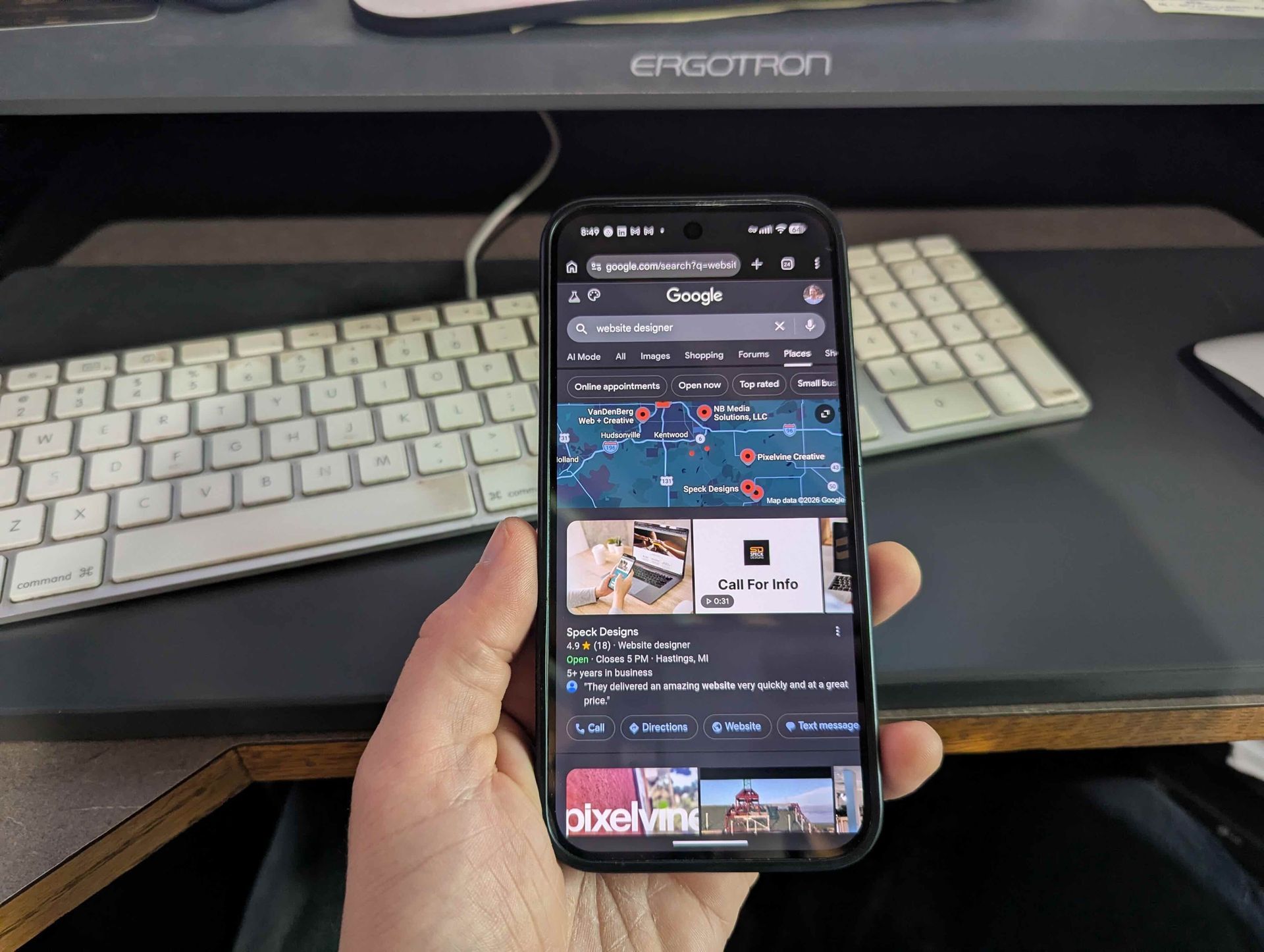
Strengthen your local visibility across Google and other places people check

Your website is only one piece of the puzzle. When it comes to local SEO, AI search tools look for widespread agreement across the internet to verify your credibility.


This matters significantly for local services because search results often shift based on geography. A person asking a question from one city will frequently see different recommendations than someone living in a county away. Even when a platform is not fully personalizing every answer, general geographic context shapes what the AI deems relevant.


Many business owners underplay this aspect because directory listings feel secondary to their own websites. That is a mistake. For local service businesses, your Google Business Profile acts as the primary source of truth, providing a quick summary for AI to digest.


Keep your business profile complete and current

Your Google Business Profile must feature the correct category, services, hours, phone number, website, photos, and an accurate business description. The same principle applies to Bing Places, Apple Business Connect, Facebook, Yelp, and any industry-specific directories that matter in your field. These directory listings serve as high-value citations that tell AI platforms exactly where you operate and what you offer.


An incomplete profile sends the wrong message. The same applies to a profile that has not been updated in months. Make sure your GBP is always optimized by utilizing our Get Real Leads service.


Make sure your name, address, and phone number match everywhere

This is tedious work, but it is essential for building strong brand signals.


If your website lists your location as Suite B, your directory listing omits the suite, and your Facebook page uses an outdated phone number, your digital trust takes a hit. Small inconsistencies pile up, and when the data is conflicting, AI cannot determine which version is correct. By maintaining uniform information across every platform, you provide the clear brand signals necessary for these tools to confidently surface your business.


Collect and respond to reviews with a steady process

Reviews do more than improve your click-through rate; they provide evidence of actual customer experience.


Do not chase a temporary burst of reviews and then disappear for six months. Instead, build a repeatable process where you ask for feedback immediately after a job is completed. You should also respond to both positive praise and negative complaints. Engaging with your community in this way increases your user engagement signals, proving to search engines that your business is active, reliable, and worthy of being recommended.


Publish content that answers buying questions, not just sells

Most service business content is too broad to be truly helpful. Generic "why choose us" pages and vague blog posts do not give AI tools much to work with.


Better content meets the buyer where they are, usually somewhere between confused and cautious. A recent breakdown of small-business AI visibility makes a good point: smaller local companies can beat bigger brands when they answer a specific question better and closer to home.


Think like a buyer, not a marketer. What are they worried about before they call? Focus your content creation efforts on specific concerns like cost, project timelines, appointment expectations, or how to compare providers. These topics allow you to target long-tail questions that AI systems prefer because they provide direct, helpful answers to user intent. Within your articles, use descriptive internal anchor text to link to your core service pages and contact forms. This helps AI models understand the relationship between your educational content and your actual business offerings. By addressing these pain points and linking strategically, you also improve user engagement, as visitors are more likely to stay on your site when they find the exact information they need.


Note that this is not about keyword density. Stuffing keywords into your text to try to hit a specific percentage is an outdated practice that often hurts readability and confuses AI systems. Instead, focus on natural language and semantic relevance. AI tools are sophisticated enough to understand your expertise through context and helpfulness, not the frequency of specific phrases.


Use local language where it feels natural

Add city names, neighborhoods, and service areas where they make sense. Mention the kind of customers you work with and the places you actually serve.


Avoid keyword stuffing by repeating the same location over and over in a single paragraph. Instead, focus on conversational, natural phrasing that includes local context. Clear, helpful mentions of your service area are sufficient for AI tools to understand your geographic relevance without making the copy read like a spammy directory.


Show proof, not just claims

This is where many small businesses stay too vague. They claim to be experienced, reliable, and customer-focused, but so does everybody else.


To stand out, incorporate multimodal search assets such as photos and videos. Visual evidence acts as powerful social proof that builds immediate credibility. Publish short case studies, include before and after examples, and provide project details or timelines. If you publish advice articles, make it obvious who wrote them and why that person is an expert. Anonymous content is significantly harder to trust than content clearly tied to a real business and real people.


A practical 30-day plan to improve your chances in AI answers

Don't try to fix twenty things at once. Start with the pages and profiles that already influence leads.

Here's a simple, actionable 30-day plan to build your authority:

Week Focus Area Actionable Tasks
1 Technical Foundations and NAP Consistency Tighten your homepage, contact page, and Google Business Profile. Focus on technical SEO and structured data to ensure your service, location, hours, and phone number are obvious and machine-readable.
2 Semantic Service Page Optimization Create or rewrite your top service pages so each one covers one specific service, one target audience, and the necessary local context to improve semantic relevance.
3 Informational Content and FAQ Strategy Add FAQ sections to your key pages and publish content that answers buyer-specific cost, timing, or process questions. Use JSON-LD for FAQ schema markup to help search engines parse your content.
4 Trust Signal and Social Proof Strengthening Implement a workflow to ask for fresh reviews, reply to existing ones, and add testimonials, project photos, or case examples to your site to prove business activity.

Don't worry about publishing ten blog posts before fixing the basics. Broken trust signals hurt your performance every time.


The point is not to hack AI. It is to remove doubt. Whether you are aiming for inclusion in Google AI Overviews or Microsoft Copilot, the goal is to make your business easier to read and safer to recommend. If you are waiting for one plugin or one prompt trick to do the work, that is the wrong assumption. Successful AI search optimization requires a solid foundation, including traditional link building and consistent structured data, to succeed. If the problem runs deeper than one page, it may take broader professional branding and web design services to fix the whole system.


AI Search Visibility Frequently Asked Questions

Measuring success in AI search optimization requires tracking brand mentions in AI-generated answers and monitoring shifts in traffic from conversational search queries. You should also analyze your Google Business Profile performance and check for improvements in organic traffic that bypass traditional click-through patterns, as these often indicate successful inclusion in AI overviews.


Why is my website failing to appear in AI search answers?

Your website likely lacks the specific, machine-readable details that AI systems require to verify your authority. If your copy is too vague or if your business information conflicts across different online platforms, AI tools will hesitate to recommend your business over clearer competitors.


How do I make my content more machine-readable?

Focus on creating dedicated pages for each core service rather than grouping them together, and use clear, plain language that directly answers common buyer questions. Implementing structured data, such as FAQ schema markup, allows search algorithms to quickly identify and extract the most important information from your pages. Using schema markup effectively helps search engines parse your content, making it much easier for AI tools to categorize your services accurately.


While there is no single, all-in-one AI auditing tool, you can use standard technical SEO platforms to scan for broken links, slow page speeds, and missing schema markup. Tools like Google Search Console and various structured data testing services are essential for verifying that your business information is machine-readable. Cross-referencing your site data against your Google Business Profile and other local directories will help you identify inconsistencies that might be confusing AI systems.


Do I need to be a large company to rank in AI overviews?

Not at all; in many cases, smaller, hyper-local companies can beat large brands by providing more specific, relevant answers to local search queries. By maintaining an accurate Google Business Profile and answering real customer questions about pricing or process, you build the trust signals that AI overviews prioritize when summarizing information for users.


How important are reviews for AI search optimization?

Reviews serve as critical social proof, signaling to AI that your business is active, reliable, and verified by real customers. A steady, ongoing process of collecting and responding to reviews provides the engagement data necessary to improve your visibility in AI-curated search results, which ultimately drives more high-quality referral traffic to your website.


The goal is to be easy to recommend

AI search rewards clarity, consistency, and proof. Small businesses do not need the biggest brand or the biggest budget, but they do need cleaner signals than the competition. Mastering AI search optimization helps your brand capture zero-click answers that position you as an authority, while still driving qualified referral traffic back to your site. By prioritizing consistent AI search optimization, you ensure that every part of your digital presence works together to build trust and long-term search visibility.


To improve your standing, consider adding data visualizations to your high-value pages, as these elements enhance semantic clarity for AI models processing your content. Open your homepage, Google Business Profile, and top service pages this week to look for anything vague, outdated, or unverified. While you are auditing these areas, take a moment to verify your structured data integrity on the homepage to ensure search engines can easily parse your business information. Implementing these proven tactics for better AI search optimization is usually the difference between simply having a website and becoming a trusted recommendation in an AI-generated answer.


Schedule a call with us if you would like to discuss improving your website's AI visibility.

Steven, the owner of Speck Designs in front of mountains.

The copywriting team at Speck Designs writes about branding, web design, SEO, content strategies, and much more for service-based businesses. Our goal is to publish clear, usable guidance you can apply right away, whether you are improving a local SEO foundation, building better landing pages, or tightening your brand message. We focus on what drives leads, not just traffic.


Ready to see how Speck Designs can help you keep your best clients and fuel business growth? Schedule your call today. Let's build lasting client partnerships through elevated customer engagement and powerful reputation management together.


Person in blue shirt viewing a desktop monitor showing “UNBREAK IT” and code in a workspace.
By SD Team May 5, 2026
AI logo designs can look fine on screen and still fail in print. See why one image isn't a finished logo, and what files you actually need.
A man is using a lapotop to complete an online form on Lakeshore Barrier Frees website.
By SD Team April 21, 2026
Learn how to build website service area pages that rank in Google, match local intent, avoid duplicate content, and turn nearby searches into leads.
Infographic comparing a thriving business with an online presence against a stagnant business without one.
By SD Team April 14, 2026
Can a website designer help grow your business? Yes, by building a site that earns trust, ranks in search, and turns visitors into real leads.
SHOW MORE BLOGS